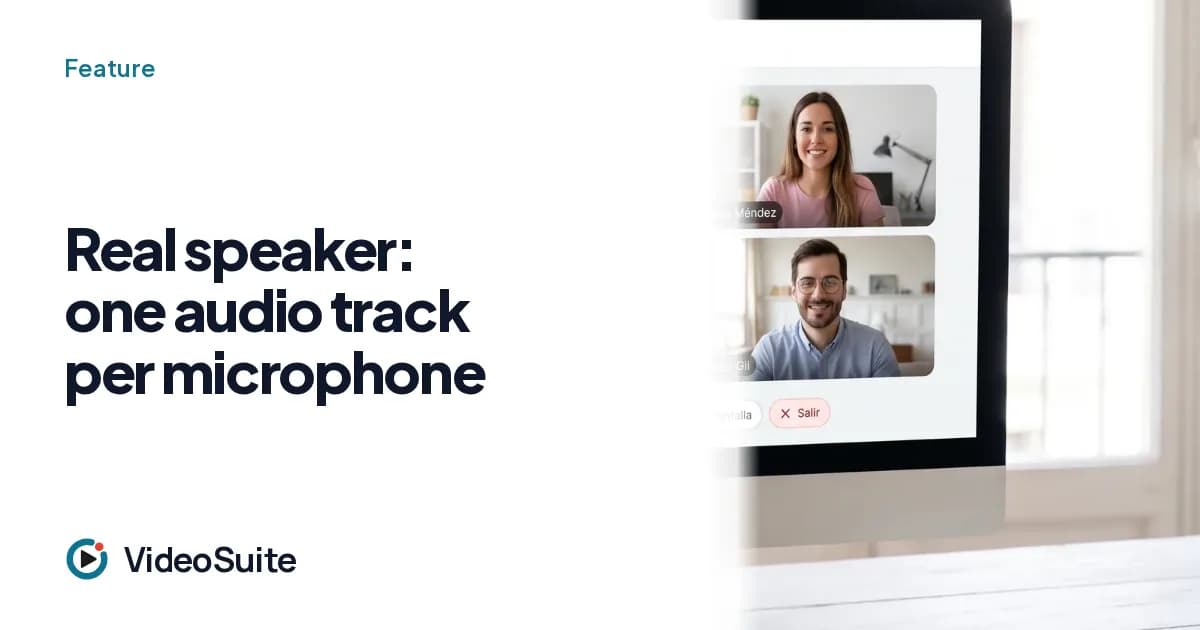
Most note assistants receive mixed audio and have to work out who is speaking (diarisation). VideoSuite, recording its own room, keeps one microphone per track: the owner of the track is the real name of the person who joined. So in live meetings the attribution of a sentence comes from the system, not from an estimate.
Who it is for
For anyone who needs to know for certain who said what: a committee, a client consultation, an interview.
What it does, step by step
- Each microphone is recorded on its own track, in parallel with the composed recording of the meeting.
- The transcript is aligned with word-by-word timestamps.
- The host picks the meeting language when creating it (Spanish, English, Portuguese, French, German, Italian or Turkish); if nobody picks one, the transcription engine detects it and the report comes out in that language.
- The viewer shows lanes per speaker, jump by minute and highlighting of the word being spoken.
- When several people share one device, or when an external recording is imported, diarisation is used, and the host can assign a name to each voice.
Honest limits
- With a shared device or imported recordings the voice has to be guessed, as in other tools.
- If someone joins with an inexact name, the transcript carries that name.
Which plans include it
What each plan includes, with prices and the own-brand extra, is in the plans section of the site: VideoSuite's features are described here as they work today in production, and some (such as own brand or own domain) depend on the plan.